

Conscience and Discernment
learning to listen for G-d's voice and learning to seek G-d's guidance

Spiritual corruption is worse than the fall of a sinner, for it is a comfortable and self-satisfied form of blindness. Everything then appears acceptable: deception, slander, egotism and other subtle forms of self-centredness, for “even Satan disguises himself as an angel of light” (2 Cor 11:14). So Solomon ended his days, whereas David, who sinned greatly, was able to make up for disgrace. Jesus warned us against this self-deception that easily leads to corruption. He spoke of a person freed from the devil who, convinced that his life was now in order, ended up being possessed by seven other evil spirits (cf. Lk 11:24-26). Another biblical text puts it bluntly: “The dog turns back to his own vomit” (2 Pet 2:22; cf. Pr 26:11). — Gaudete et Exsultate, para 165
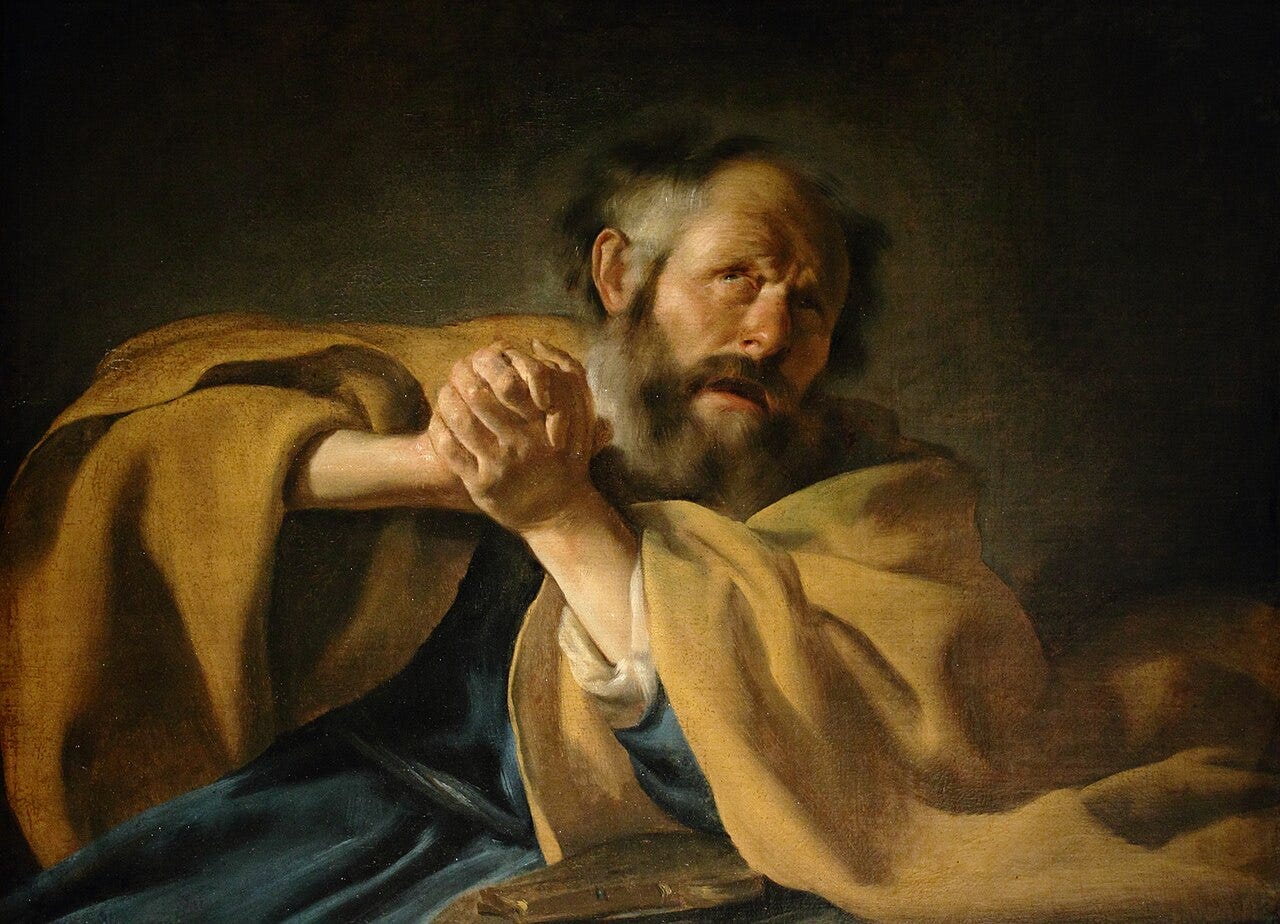
artwork: The Repentance of St. Peter, Johannes Moreelse, c. 1630, oil on canvas
In his 2018 Apostolic Exhortation Gaudete et Exsultate (which translates to English as rejoice and be glad), Pope Francis stated that only through discernment can we tell if something comes from the Holy Spirit, the spirit of the world, or the spirit of evil. Discernment requires more than common sense or even intelligence. Discernment comes from the Holy Spirit. We develop this gift from the Spirit through prayer, silent reflection, and reading Scripture1 — essentially the stuff I wrote about for Good Shepherd Sunday. Yes, learning discernment means learning to listen for and hear (and in turn, act upon) the voice of Jesus. Discernment requires a well formed conscience.2 Because otherwise, how do we know the voice we hear? How can we tell where it comes from? How can we determine what spirit it is from?3 Conscience. We need conscience to help us exercise discernment.
“Certainly, if I am obliged to bring religion into after-dinner toasts, (which indeed does not seem quite the thing) I shall drink, —to the Pope, if you please, still, to Conscience first, and to the Pope afterwards.” — St. John Henry Newman
What is conscience?
Very simply, Christians can describe conscience as the voice of Jesus speaking into the inner sanctum of a person’s heart, the heart serving as the seat of intentionality.4 In his 1875 letter to the Duke of Norfolk, John Henry Newman described conscience as the messenger of G-d, and the first of all the vicars of Christ.5 According to professor of theology and Catholic priest Samuel Fernandez, Vatican II and the ecclesiastical Magisterium that emerged from it has outlined three dimensions of conscience:
the conscience as the instrument for recognising the law of God
the conscience as an act of judgment
the conscience as the place of encounter with God.6
Paragraphs 1776 and 1778 of the CEC together provide a beautiful definition of conscience, “Conscience is the most secret core and sanctuary of a person. There, each one is alone with God, whose voice echoes in the depths of the heart … [It is] a judgment of reason whereby the human person recognises the moral quality of a specific act that he or she is considering, is currently performing, or has already performed.”7 In his 2016 Apostolic Exhortation Amoris Laetitia, Pope Francis wrote that conscience “can also [help us] recognize with sincerity and honesty … the most generous response which [we can give] to God” given our own personal limits and the external limits placed upon our freedom to act (Amoris Laetitia para 303).
So, by conscience we mean the inner core of the seat of intentionality, the place where we sit alone with G-d, whose voice echoes through our heart. We mean a place where we form intention, either by choosing G-d, or rejecting Him. We mean a place where we can choose a course of action based on the limits which the situation imposes on us and based on our own personal limitations. By conscience we mean the part of us that enables us to take responsibility for our speech, behaviour and actions.
“Examine yourselves to see whether you are living in the faith. Test yourselves. Do you not realize that Jesus Christ is in you?” (2 Cor 13:5)
So, we learn to listen for the voice of Jesus, we learn to locate within ourselves that secret core where G-d meets us … and then what? How do we get from conscience to discernment? In his Modern Catholic Dictionary John Hardon, SJ describes examination of conscience, as reflecting on the state of one’s soul in G-d’s presence. Again, we have the strong implication of conscience as the place within ourselves where we meet G-d. Not only that, Hardon’s nomenclature denotes a capacity to test oneself against G-d.

photo: taken by me
Need for discernment
For my Sola Scriptura readers, rest assured that this doctrine of conscience does have a Biblical root. In 2 Corinthians 13:5, Paul tells the church at Corinth, “examine yourselves to see whether you are living in the faith. Test yourselves. Do you not realize that Jesus Christ is in you?” The Greek word used for examine in this passage, dokimazo δοκιμάζω,8 means to scrutinise something to determine its genuineness. The Greek word used for test in this passage, peirazo πειράζω,9 has a slightly different meaning from examine, in English a synonym for test. Peirazo refers to inspecting for weaknesses and faults — imagine a kind of assessment of your capacity to resist temptation.
In 1 Timothy 4:2, Paul writes about “the hypocrisy of liars whose consciences are seared with a hot iron,” and similarly, in Titus 1:15, he observes that “to the corrupt and unbelieving nothing is pure. Their very minds and consciences are corrupted.” Here he speaks of those who commit habitual evil to the extent that it has shut off or burned out their conscience, leaving an imprint of sin which they project onto everything and everyone around them. We all can think of examples of the false piety of such hypocrites who suffer with a corrupted conscience. Incidentally, the Greek word used for conscience, syneidēsis συνείδησις,10 refers to one’s inner moral witness, and literally means knowing with [oneself]. That takes us back to the beginning of this essay, a dog turning back to his own vomit.

In order to consider the impact of a damaged or corrupted conscience, we need to consider “the conscience as the seat of freedom of judgement, and as the place of encounter with G-d and self.”11 A dog eats his own vomit in attempt to resource guard, and a person with a seared conscience will routinely employ ego defence mechanisms such as projection, displacement, sublimation as a means of self-guarding. The conscience becomes deadened, the person feels an inconsolable and existential pain, like s/he has a gangrenous heart and spirit. Such a person develops a serious case of self loathing. Such a person has closed herself off to G-d as source of unconditional love and mercy, as a source of LOVING authority.
Doesn’t membership in the body of Christ, ie. belonging to the church, help us to form a healthy social character? Ideally, yes. Practically speaking, often it has the opposite effect.
“Discernment must help to find possible ways of responding to God and growing in the midst of limits. By thinking that everything is black and white, we sometimes close off the way of grace and of growth, and discourage paths of sanctification which give glory to God. Let us remember that “a small step, in the midst of great human limitations, can be more pleasing to God than a life which appears outwardly in order, but moves through the day without confronting great difficulties”.” — Amoris Laetitia, para 305
Here I mean both Old and New Testaments.
Berlage, Laura. 2013. Discernment, Conscience, and the Interior Life, in Ad Infinitum Blog. Catholic Apostolate Center.
To riff off of the phrase from Luke 9:55, “you do not know what spirit you are of.”
See Proverbs 4:23, Proverbs 16, Jeremiah 17:9, 1 Samuel 16:7, Matthew 15:18. Also the heart as the seat of intention is a foundational teaching in Judaism, which teaches about Yetzer Hara and Yetzer Hatov, the Evil and Good Imaginations of the Heart. The heart actually has neurons that function independently from and communicate with the brain.
John Henry Newman, Letter to the Duke of Norfolk, section 5 via National Institute for Newman Institute.
Fernandez, Samuel. 2021. Towards a Definition of Abuse of Conscience in the Catholic Setting, in Gregorianum 102, 3 (2021), p. 559.
See also Gaudium et Spes, para 16
Fernandez 2021, p. 560
Consciousness and Conscience,
⛪📿🕯️ Watch and pray......
https://claude.ai/public/artifacts/fb4b5d13-c5ff-4d05-9459-5225992c26b5
Grace and peace to you sister,
CHRIST is RISEN!