

Self Revelation? Hostile Takeover of the Catholic Church? Doctrinal Dilution? Communal Discernment?
a close look the Synodal Study Group No. 9 Report on homosexuality

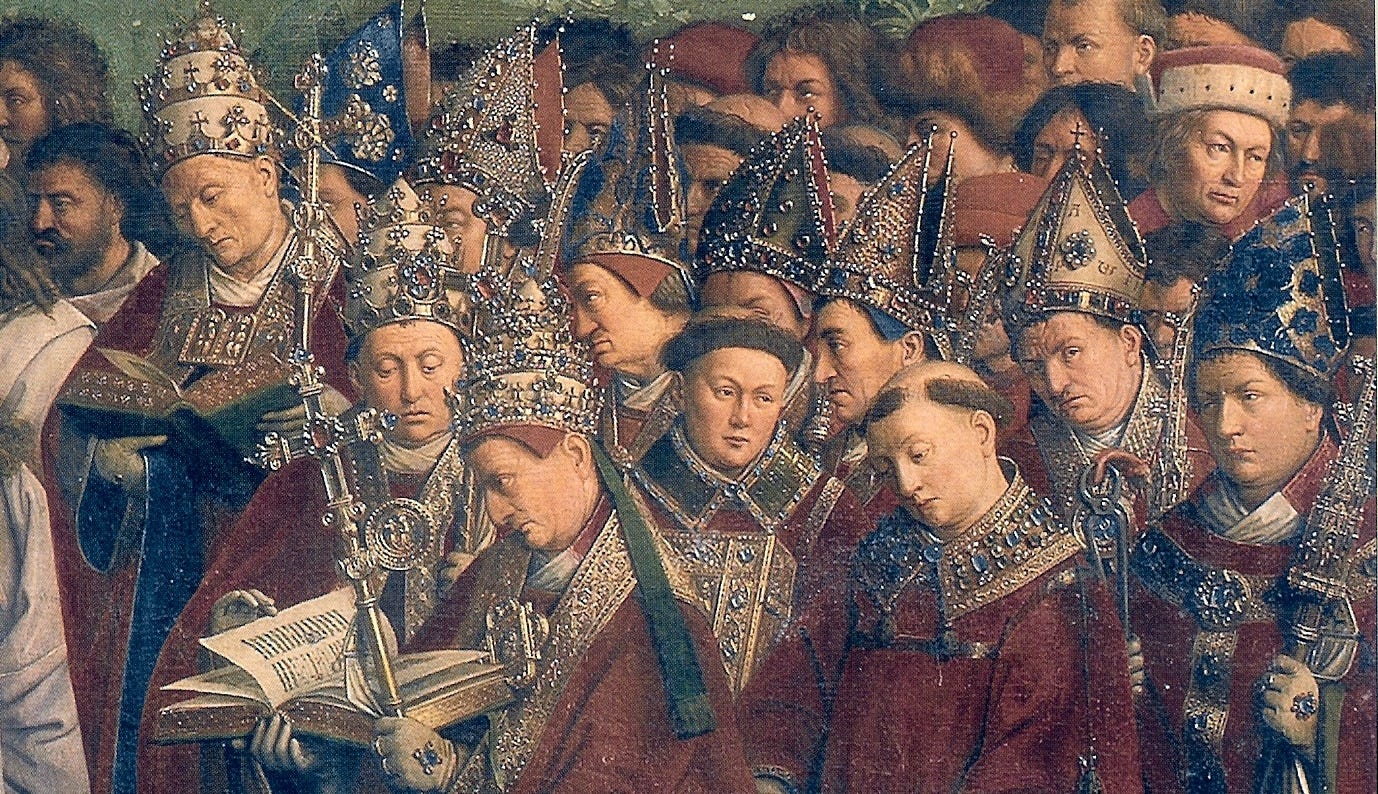
artwork: Ghent Altarpiece [Popes Martin V, Gregory VII and Antipope Alexander V with bishops] by Jan van Eyck, 1432, oil on panel
Note to readers: at nearly 5700 words, this post is quite lengthy and may appear truncated in your email, you can click through to the website to view and read the post in its entirety.
The Farcical Nature of Pope Francis’s Synod on Synodality
“Just as this theory denies the individual, it also denies the universal. There are no universal truths, no objective reality, just narratives that are expressed in discourses and language that reflect one group’s power over another. There is no distinction between objective truth and subjective experience, because the former is an illusion created by the latter.” — Andrew Sullivan, The Roots of Wokeness, July 31, 2020
It’s no secret to anyone plugged into the Catholic world that Pope Francis lit up a controversy by way of his Synod on Synodality process. Many perceived this move as an attempt to protestantise the Catholic Church, to prioritise the voice and opinion of laity over established doctrine and law of the Church. The emphasis on “active listening” to “lived experiences” of the marginalised in the Church, seems to come at the expense of the established hierarchy of the Church. The reference to realisation of “sound decentralisation” sounds saccharine and empty. The progressive pre-determined outcomes of the process seem to edge out or dilute the apostolic authority of bishops with in the structure of the Church.
The closure of the synod without any Apostolic Exhortation leaves the Church in a kind of strange limbo, in a place of doctrinal uncertainty.
For all the talk of unity, this certainly does not bode well for unity — it drives the traditionalists further afield into radicalism. To govern by lived experience does indeed lead to decentralisation, nothing sound about it, though. When we decide to forgo universal truth and objective reality, then we have veered in self revelation and self idolatry territory,
“The basis of the Church is the word of God as a revelation ... not our strange reflections. ... This [agenda] is a system of self-revelation. This occupation of the Catholic Church is a hostile takeover of the Church of Jesus Christ. ... And if you look at only one page, or read one page of the Gospel, you’ll see that it has nothing to do with Jesus Christ ... and [in this agenda] they think that doctrine is only like a program of a political party, who can change it according to their votes.” — Cardinal Gerhardt Müller
Below I’ve provided an excerpt from the Notes of Pope Francis on the Final Document. Having read the document, I see that it contains the same fluffy and empty language which the Study Group 9 Report contains. It’s reminiscent of Woke methodology and manipulation: using a lot of nice sounding pie-in-the-sky words to say very little — the stuff of power discourse and posturing. Pope Francis’s appointment of captain rainbow James Martin to the synod raised eyebrows. Bishop Barron noted that the American delegation had an ideological balance to it, and he trusted the Pope that the Synod would focus on “strategiz[ing] about how to effectively evangelize and accompany people from all walks of life” rather than on doctrinal reforms.
If that’s the case, why did Francis appoint a priest with a public reputation for ideologically skewed views on sexual ethics? In fact, Jason Steidl Jack delivered one of the testimonies examined by Study Group 9. Readers may or may not recall the theologian and assistant professor at Fordham University, together with his husband Damian Steidl, received a blessing from Fr. Martin immediately after the pope’s announcement that Catholic priests may bless same-sex couples. This seems like a fairly privileged and well connected bloke, and not someone living in the margins. Perhaps that’s my cynicism speaking. Perhaps it is not.
Point being — at a time when people generally harbour deep mistrust for institutions, Pope Francis has created a situation where many conservatives and traditionalists harbour a deep mistrust for the institution of their own Church.
Acknowledging the value of the synodal journey undertaken, I now hand over to the whole Church all that is contained in the Final Document restoring to the Church what has matured over these years through listening and discernment and as an authoritative orientation for the Church’s life and mission.
The Final Document is part of the ordinary Magisterium of the Successor of Peter (cf. EC 18 § 1; CCC 892), and as such, I ask that it be welcomed and received. It represents a form of exercise of the authentic teaching of the Bishop of Rome that has some novel features but which, in fact, corresponds to what I had the opportunity to point out on 17 October 2015, when I affirmed that synodality is the appropriate interpretative framework for understanding hierarchical ministry.
In approving the Final Document on 26 October, I said that it ‘is not strictly normative’ and that ‘its application will need various mediations’. This does not mean that it does not commit the Churches from now on to make choices consistent with what is stated in it. The local Churches and groupings of Churches are now called upon to implement, in their different contexts, the authoritative proposals contained in the Document … Unity of teaching and practice is certainly necessary in the Church, but this does not preclude various ways of interpreting some aspects of that teaching or drawing certain consequences from it. This will always be the case as the Spirit guides us towards the entire truth (cf. Jn 16:13), until he leads us fully into the mystery of Christ and enables us to see all 4 things as he does. Each country or region, moreover, can seek solutions better suited to its culture and sensitive to its traditions and local needs.’ (AL 3). — Accompanying note [to the For a Synodal Church: Communion, Participation, Mission Final Document] by the Holy Father Francis
It’s worth sharing Cardinal Zen’s reaction to this synodal process and the Notes of Francis. “The ironclad manipulation of the process is an insult to the dignity of the Bishops, and the continual reference to the Holy Spirit is ridiculous and almost blasphemous (they expect surprises from the Holy Spirit; what surprises? That He should repudiate what He inspired in the Church’s two-thousand-year Tradition?).” To repeat, Cardinal Zen considers the whole process “an ironclad manipulation”, and “an insult to the Bishops,” and he points out the vague language of the document and the inherently heuristic nature of the synod process as inviting contradictory interpretations. The repeated invocation of the Holy Spirit does seem impertinent and even blasphemous. This will all entrench deep divisions in the Church, amongst not only the faithful, but also the clergy and the episcopacy. Finally, after raising some vital concerns regarding the implications for ecumenism, Cardinal Zen notes that “Pope Bergoglio has exploited the word Synod, but has made the Synod of Bishops—an institution established by Paul VI—disappear.”
I have zero interests in returning to pre-Vatican II Church culture or traditions, however the pendulum swings and I don’t fault conservative catholics and traditionalists for flexing their disdain of Vatican II, though I think it’s the cheap and diabolical weaponisation of Vatican II they disdain, and not Vatican II itself. The Traditional Latin Mass and other trappings of pre-Vatican II Church culture absolutely do not interest me, they repel me. I do not see this as the panacea, I see it as a misguided response. Just so we are clear here about this.
Does Doctrine and Law No Longer Matter in the Church?
“Others continued to express the pain of feeling excluded or judged because of their marital status, identity or sexuality,” says the Final Document of the Synod on Synodality.
Reader, that sounds like a plea for affirmation, it sounds like a veiled attempt to set up a dilution or outright changing of Church doctrine to appease to feelings of those living in violation of said doctrine. I have just read a Facebook post by Sal Grover, in which she recounts that Australia’s Sex Discrimination Commissioner thinks that trans women — that is men who think they are women and identify as women and demand that society affirm their identity as women — should receive the pregnancy protections afforded to female people. In this context, I think this feeling excluded and judged which same sex attracted men report smacks of a demand to have doctrinal reality altered to affirm them.
Reader, it is undeniably the modus operandi of the rainbow movement to demand fealty by means of affirmation. Not acceptance, affirmation.
Study Group 9 produced a final report echoing this sentiment throughout. Whether I agree with their ideological stance entirely, I’ll say here that conservatives and traditionalists have a right to express concern and outrage over what they’ve read in the report by Study Group 9. This process has fractured the body of Christ, it has fractured the Church. Doctrinal dilution leaves the faithful of the Church feeling uncertain and fearful and abandoned by the leadership of the Church.
Receiving Holy Communion Whilst Not in a State of Grace
Why are men who persevere in a state of mortal sin (according to the Catechism of the Catholic1 Church) receiving communion? Whenever I attend mass, the priest always reminds the congregation of the requirements for holy communion — baptised Catholics who have received the sacrament of Holy Communion, and who remain in a state of grace through the sacrament of confession, ie not in a state of mortal sin. Those who live a lifestyle in which they have sex outside of the bounds of the sacrament of marriage, as defined by the Church2, by definition live in a state of mortal sin, and must cease doing so and then go to confession and receive absolution.
To repeat, to have a sexual relationship outside of the bounds of the marriage sacrament is to commit a mortal sin and render one unworthy of the sacrament of Holy Communion. I didn’t make the rule up, you can check it out here, in the Catechism of the Catholic Church (CCC). In particular, the CCC3 states clearly the Church doctrine regarding homosexuality. Per article 2357, “tradition has always declared that “homosexual acts are intrinsically disordered.” They are contrary to the natural law. They close the sexual act to the gift of life. They do not proceed from a genuine affective and sexual complementarity. Under no circumstances can they be approved.”
According to Canon 915, those “obstinately persevering in manifest grave sin”4 cannot receive Holy Communion. Like I said, don’t shoot the messenger, I didn’t create the rule, I’m reporting it. The doctrine as summarised in the CCC and (Canon) law of the Catholic Church make the Church’s expectations for the faithful very clear. The Holy See makes it available in many languages for all to see. It ain’t a secret, reader. It’s been this way as long as I have lived, that’s over half a century, and a lot longer than that.
Given the reality of the doctrine and law of the Catholic Church that I’ve just stated, my first response to the two testimonies of married gay men, in Appendix A of the Study Group 9 Report looked like a mixture of surprise and puzzlement. In the first testimony a gay man in a gay marriage recounted how the Eucharist anchors his spiritual life. So, depending on where one lives, the Church can bend the rules and hand out Holy Communion to those in a prolonged state of mortal sin … because, why? When did we decide that affirming an unchaste gay man by giving him Holy Communion > following the catechism and Canon law?
What is the point of a Magisterium, then?
Maybe it seems assholish to have spent so much time on that minor detail. I don’t consider it a minor detail, though. I consider it crucial to the Catholic faith life. Does “a preferential option for the marginalised in the Church” mean the rules don’t apply to certain designated marginalised? Because then that seems unfair to everyone else who faithfully lives their life according to the catechism and Canon laws set out to guide the faithful. It mocks the sanctity of the Eucharist as a sacrament. Why does this happen? Who thinks this a good and morally sound idea? And who defines marginalised? Because the Wokerati have a way of redefining marginalised to mean the privileged who don’t want the rules and norms to apply to them. Since the report begins by mentioning parrhesia, I figure my observations and questions constitute fair game in this discussion. Readers can ponder that on their own.
parrhesia παρρησία refers to candid speech, ie. speaking freely. It implies not only freedom of speech, and beyond that, the obligation to speak the truth for the common good, even at personal risk.
Moving on to the body of the report.
Final Report of Study Group 9
As mentioned, Study Group 9 embraces parrhesia in addressing the subject matter. The Gospel remains the same as it always has, the Spirit moves us, we, the in the world which evolves and changes across time and place. The Study Group uses lots of lovely language, such as “conversation of the heart and mind … discern[ing] with G-d’s grace … changing our usual mental and behavioural habitus … listening for what is true and by by attending to questions that emerge from the reality of lived experience … clarification of concepts [that] has fostered dialogue, exchange, and the interweaving of perspectives.”
Blah blah blah, reader can we cut the flowery lingo and get to the point?
So the Study Group decided to rename controversial issues to emerging issues. Controversy tends to invite polarisation and debate, and this tends to create divisions. Whereas emergence reframes the situation as an opportunity to deepen understandings of the Gospel for our modern society’s “diverse situations and communities.” Context, that favourite word of Wokerati ideologues, appears a few times in Study Group 9’s report —along with human experience, pastoral listening, cultural diversity, and communal discernment.
Reader, as someone who has studied Wokerati culture and methodology for a number of years, I can tell you this language resembles the language of deception and power discourse.
The Study Group invokes the Jerusalem Council in chapters 10 through 15 of the Book of Acts as a model for the synodal process the Catholic Church ought to follow in revisiting the issue of homosexuality, the same sex attracted, and the ways their faith journey intersects with the Church. Essentially at this Council, Paul, Peter, and James led a discussion on whether or not Gentile converts to Christianity needed to follow the Mosaic laws, including circumcision. The Council ruled that Gentiles did not need to undergo circumcision.
Half Truths and Sleight of Hand
In a bit of a deceptive move, the Study Group quotes the first part of Acts 15:28, for it has seemed good to the Holy Spirit and to us. While the Study Group remains coy about this, it seems they have in mind a similar scenario for the Church vis à vis Church doctrine regarding homosexuality and same sex unions. Meaning, well, the apostles said that the Holy Spirit led them to remove the requirement for circumcision for Gentiles joining the Jesus movement, so maybe the Holy Spirit is leading us to remove the Church doctrine on sexual ethics and chastity vis à vis homosexuality. Oh but we don’t want to change doctrine, we only want to figure out how to walk with people in their diverse lives. That’s all well and good, however, consider that the rest of verse 28 and verse 29 roots the quoted passage in its own reality: to impose on you no further burden than these essentials: that you abstain from what has been sacrificed to idols and from blood and from what is strangled and from fornication. So, the Council of Jerusalem imposed the essential burden of abstaining from fornication. It’s right there in the New Testament, reader — I didn’t make that one up!
Abstaining from fornication — that’s a clear apostolic ruling for the faithful of the Church.
“the recognition of issues that we today regard as ‘controversial’ can represent, in a positive light, the emergence of experiences that urge the Church to grasp and express, at an unprecedented and deeper level, its own appropriation and articulation in the present moment of history, and within the diversity of contexts and situations, of the timeless message of the Gospel intended for all. It is in this spirit that synodal discernment of these life experiences must be exercised, starting from their accounts, with attentive and open listening both to the Word of Jesus – made alive and relevant by the Holy Spirit within the space of ecclesial communion and with attention to the “signs of the times” – and to what the People of God have experienced in diverse cultural contexts and in relation to various life situations.” — Study Group 9 Report, p. 6
Since we have embraced parrhesia and all, I will speak frankly here. Reader, that’s a lot of words to say that Study Group 9 wants the Church to get with the times and change its doctrine on homosexuality to affirm the rainbow community. Oh, but don’t worry, because apparently it’s a heuristic document and process.5 We will have Conversations in the Spirit centred on the value of pastorality, reader. It will be fabulous. Kumbaya. Oh, and anyway, we should, as Catholics, resist “the temptation of the sterile and regressive ossification of principles and statements, of norms and rules, regardless of the experience of individuals and communities,” you know because Jesus did say in Mark 2:27 that healing on the Sabbath was not really violating the spirit if the day, so that must mean we can drop the rules about chastity and sexual ethics to have the Church doctrine conform to and affirm the rainbow identity lobbyist movement (p. 9). Rules are boring that shouldn’t apply to meeeee, reader. Apparently we must negotiate the eschatological reality with the ever-changing worldly reality. Apparently the doctrine of marriage and chastity enters into this negotiation.
Verbal Soufflé of Wokeness
Doctrine isn’t static, is what we glean from this saccharine verbal soufflé that Study Group 9 has cooked up. Well, if that’s the case, then what other commandments do we figure could go up for grabs? Since we’ve decided we can make Commandment 6 optional, maybe we could make Commandment 5 optional too! Then we could solve those pesky euthanasia and abortion issues that keep popping up. Oh, that’s not what doctrine isn’t static means? Oh, okay, sure thing. By heuristic the Wokerati Synod means we are gonna make this up as we go along, then, huh?
Reader, does Study Group 9 really intend the Church to reframe doctrine as something interpreted within an ongoing historical process? Does the rainbow lobby want affirmation from the doctrine of the Catholic Church now? Why are we even entertaining this possibility?
Welcoming the same sex attracted, the divorced, the remarried, the cohabitating, need not entail changing the Church doctrine and law to affirm their life style and choices. We live in the tension of G-d’s law and the worldly reality of our lives, and G-d does not intend us to solve that tension, He intends us to live in the tension with grace and love and humility. We can and must begin there — how can we strike a balance between doctrine and pastoral care? How can we welcome those in the (sinful) margins and treat them with dignity and grace and love and remain true to G-d’s Commandments? If we love Jesus, we follow His Commandments, to the very best of our capacity. Remembering that He described as the two most important Commandments that lead to all the others, 1) love G-d with all your heart, soul, and mind and 2) love your neighbour as yourself. When we fall short, we pray and humbly confess and repent. We seek pastoral guidance for situations where we risk persevering in sin. We come off as pretty arrogant and entitled when we expect that G-d should alter His law because of our modern challenges. Who do we think we are, anyway?
What do we think it means to say that “God's gift of grace … is realized and received personally through a response of faith” (p. 10)? I don’t think it means what Study Group 9 wants it to mean, reader. No, we cannot necessarily equate lived experience with G-d grace, particularly if we live outside of G-d’s law. The term “lived experience” appears a lot in this report. Anyone who’s studied Woketopian progressivism has familiarity with the term “lived experience,” and knows that progressives typically invoke it to prop up the paradigm of identity and undermine objective reality and universal truth. Affirming these identities has morphed into somewhat of an idolatry. I see that concept creep in this report document. In an almost humorous or gaslighting fashion, the report lists three dynamics to propel the synodal process: relational conversation, learning together, and transparency. Yes, reader, because the Vatican has a fabulous history of transparency! Sarcasm alert.
Indeed, human experience guides and shapes our understanding, and we ground our critical knowledge in the context of that experience, and we discern what happens in events, and G-d reveals Himself to us through our connection to others. We can agree with Study Group 9 on that much. However this does not negate universal truth and our understanding as gained through lived experience does not always align with universal truth, and when that happens, we cannot expect to alter universal truth or objective reality to serve our personal agenda. And, sadly, the Vatican has not always conducted itself in the confines of this ethic. The mishandling and evasiveness of its engagement on the sexual abuse of clergy and coercive control that’s rampant in the Church structure reminds us of this unfortunate fact. Google Marcial Maciel or read a few Jason Berry articles to see what I’m taking about. No transparency happening for the Holy See.
Pitting Pastorality Against Doctrine
Study Group 9 envisions the process of ongoing discernment to take place on the horizon of pastorality. Pastorality refers to proclaiming the Gospel while taking concrete responsibility for the real lives of people, recognizing God may already be at work in them, and accompanying people rather than merely judging situations abstractly from a “doctrinalist or even fundamentalist crystallization” (p. 16-17). When the Church becomes empty of spiritual depth at the individual and community level, “synodality [devolves into] organisational expediency.” Clever readers might think of Ellul here, who wrote that “technique is the totality of methods, rationally arrived at and having absolute efficiency (for a given stage of development) in every field of human activity,” (Fowler 2000).
Pastorality provides needed space for the strong personal relationship with the Lord that takes us beyond the individual Me and Jesus and to the ecclesial We and Jesus. Yet the Wokerati spirit of the report exudes and Me and Jesus attitude of morality. Throughout its report Study Group 9 seems to pit Grace against Doctrine, as though the Doctrine did not provide a necessary foundation for the Grace of G-d to grow in the body of Christ. Does the group intend for pastorality to somehow mediate these two polar opposites they’ve delineated?
Since we are dealing not with problems to be solved, but with the construction of the common good, primacy should not be given to the correction (at a doctrinal, pastoral, or ethical level) of situations evaluated as problematic in the concrete experience of faith. Rather, we need to prioritise the recognition and discernment of the instances that faith practices express and show in action, often through unthematic knowledge. — Study Group 9 Report, p. 17
Reader, surely the common good does necessitate doctrinal and ethical correction from a pastoral figure? Do we let our kids eat cake for breakfast and forgo brushing their teeth? No, because kids need ethical correction, that’s the job of parents. Similarly for pastoral guidance in the context of the Church and her Magisterium. “Prioritising discernment … through unthematic knowledge,” well, that sounds like a lot of fancy-speak for affirming lived experience, doesn’t it, reader? The Study group chooses the nomenclature of emerging issues over controversial issues in order to downplay the problematic nature of the task at hand. We would rather not focus on solutions, no, we choose to remain in the tension. Indeed, that’s what Christianity calls Christians to do, to live in the tension between the Already and Not Yet, or the Penultimate and the Ultimate. Ellul wrote about this, and so did Bonhoeffer. Yet the spirit of the synodal process seems to lean toward solving this tension by diluting the Doctrine and vilifying tradition and mocking the Magisterium.
Living in the Tension
If that’s indeed the case here—to live in the tension and not solve it—then what work do we have to do, other than the same sex attracted, the civilly divorced, the remarried, and those living in “free unions” simply living in the tension existing between doctrinal limits and communal participation inherent in membership to the body of Christ? Obviously this entails the entire Church to participate. Yet CCC 2358 already tells Catholics that “[the same sex attracted] must be accepted with respect, compassion, and sensitivity. Every sign of unjust discrimination in their regard should be avoided. These persons are called to fulfill God's will in their lives and, if they are Christians, to unite to the sacrifice of the Lord's Cross the difficulties they may encounter from their condition.”
“Recognizing the authority of the words exchanged and listened to is not a methodological expedient, but a decisive ecclesiological orientation,” writes Study Group 9 in its report (p. 22). But, reader, it isn’t an ecclesiological orientation, because the Church does not engage that way, and could the hierarchical nature of the Church even permit such a means of orientation?
It’s a Men’s Club of Sexual Libertinism
As I mentioned at the beginning of this essay, the Study Group decided to “clarify what is at stake” through the testimony of two gay men, each in a gay marriage, and each involved in their local church. Apparently same sex attracted women did not count as an important part of discerning what is at stake for gay Catholics. Would I expect a male dominated and misogynist organisation rife with homoeroticism to think to consult women in a conversation about including Catholics living in the margins? Of course not, this cradle Catholic knows better. Pigs will fly past my window before the Catholic Church thinks about what women’s lived experience tells any synodal process! Jesus had female followers, and Paul had female missionaries on his team of church planters. That’s known. And it’s conveniently denied and ignored.
There is No LBGTQ Community, Unless You Treat Safeguarding as Optional
I want to address the identity nomenclature used by Study Group 9. There is no such thing as the LGBTQ community. Not unless you think that 12 year olds who experience confusion about their sexual development and who struggle with embodiment in the context of their sexual development have anything in common with middle aged heterosexual men who have a paraphilia called autogynephilia. If you think pubescent children experiencing sexual confusion and discordance and disembodiment related to the natural process of growth and development should belong to a category where middle aged heterosexual men afflicted with a sexual perversion dominate, and if you thing either of these categories of humans has a wit to do with same sex attraction, then, I don’t know what to say. You’re naïve, ignorant, you’ve deep throated too much rainbow lobbyist propaganda, you’ve drunk the koolaid — pick your favourite metaphor.

The very notion of LGBTQ as a community carries with it a grave risk for safeguarding. It has homophobic undertones, and it undermines the family and obliterates women’s sex-based rights and it violates human rights generally. There is no LGBTQ, there is LGB and there is TQ. They do not belong in a forced team situation. Many gay people want the LGB to divorce itself from the TQ. The forced teaming has played out like an abusive relationship. Not to mention the TQ carries with it a disturbing contempt for the human body, for human sexuality, in addition to an alarming glorification of disembodiment as well as surgical and hormonal mutilation of the body. Gnosticism was heretical in the 2nd century, in the 12th and 13th century. It remains heretical now.
The Exegetical Flaws: Using the Bible as a Proof Text
Finally, I want to mention the scriptural basis for homosexuality as a sin. On close examination, we can see some exegetical flaws. It bears mentioning that according to the CCC (85) the final word on interpretation of Scripture lies with the Magisterium. So, whatever I think, and whatever learned and clever scholars think, the final decision on how to interpret these passages for the Catholic Church lies with the Church leadership. Nonetheless, we should approach the text humbly and carefully and with respect.
I won’t repeat what I wrote less than 2 months ago, I will direct readers back to that essay about the interpretation of the texts often used as proof texts against the same sex attracted. I do not oppose the doctrine of the Church regarding sexual ethics, including same sex attraction. Yet, I question the strength of the exegesis of the Scripture to condemn the modern neologism know as same sex attraction or homosexuality. That’s not to say G-d allows homosexuality, it’s to question the interpretation of the Scripture. Historical theology has taught us about this traditional interpretation of the Bible vis à vis homosexuality. So, it’s not as though modern biblical scholars who look at the familiar with fresh eyes will change the thinking on this. However, maybe it may give people pause before they use the Bible as a cudgel with which to morally condemn others. Jesus did not condemn sinners. He did not affirm them either. He loved them and lead them to repentance and redemption and grace.
All that said, the discussion goes beyond the way we interpret the Biblical text. Nathan Jacobs of Theological Letters has done a great job of laying out the moral ethics of LGBT in a YouTube video from September 4, 2025. I find Nathan quite brilliant and convincing, I think he’s worth your time and attention, and even a subscription.
“Once you begin to mainstream sexual activities that are not conducive to traditional family structures, then what begins to happen is you start to have the breakdown of the family. And with the breakdown of the family, what you begin to have is you have the breakdown of social fabric. And so now you have the possibility of kids who don’t have proper boundary lines in terms of morality and social behaviors.” — Nathan Jacobs
I have followed the GenderWang movement since Bill C-16 came into effect in 2016/17. I echo what Nathan says here in his Utilitarian discussion of LGBT (around the 59:38 timestamp in the video) — in Canada we have seen this play out, the attack on the family, the distortion of moral and social boundaries for young people, the breakdown of the social fabric of society. It’s undeniable. Progressives can throw a tantrum and spew words such as hateful, bigoted, homophobe, transphobe, blah blah blah … that’s emotional noise, it’s intellectually weak and stunted, and not a solid and morally sound argument. The Woke tantrums convince no one, they function as coercive control in the ongoing power discourse.
A tension exists, we cannot resolve it. We simply must learn to live inside the tension. We must take care to adopt a moral ethic that allows for built-in safeguards, that promotes the family, and that strengthens the social fabric of society, rather than eroding it. The Church plays a role here, and when it decides to abdicate its role as a moral authority for humanity to play Wokerati identity affirmation politics, with a view to reforming Doctrine and diluting the hierarchical structure of the Church, it fails in its mission as the Church of Jesus Christ. We can welcome the same sex attracted, the civilly divorced, the remarried, those living in free unions, without changing Church Doctrine over it.
The answer to the guilt borne by those living lifestyles that violate the Church Doctrine on sexual ethics and chastity does not lie in changing those Church Doctrines! Hopefully most people have enough humility and moral aptitude to realise that.
The Church has done enough damage by its grave mishandling of sexual abuse in clerical ranks. It has undermined safeguarding of minors, it has protected predacious and sex-addicted men, it has burdened families with the shame of the criminal violations of these depraved and sex-addicted and predatory men wearing Roman collars —it has very often said a giant eff you to survivors of clergy sex abuse. It seems like a gaslight to now try to sneak in loosening of sexual ethic and chastity Doctrine to affirm and appease the LGBTQ lobbyists, who have infiltrated every institution and societal structure they can and continue weaponised guilt to their strategic advantage. None of that has helped LGB people, by the way.
grave sin = mortal sin
Cardinal Zen referenced “creative activation of new forms of ministeriality” in his response to the Final Document of the Synod on Synodality.